AI-Driven Talent Acquisition Platform
Designing an AI-Driven Talent Acquisition Platform Connecting Early-Career Talent with Companies.
AI-Driven Talent Acquisition Platform
XSTRYV is an AI‑powered hiring platform built to bridge the gap by connecting next‑generation talent with companies more meaningfully and efficiently. By going beyond keyword matching and résumé screening, XSTRYV helps young professionals discover opportunities that fit their skills and ambitions, while enabling employers to find, evaluate, and hire the right early‑career talent faster and with greater confidence.
My Role
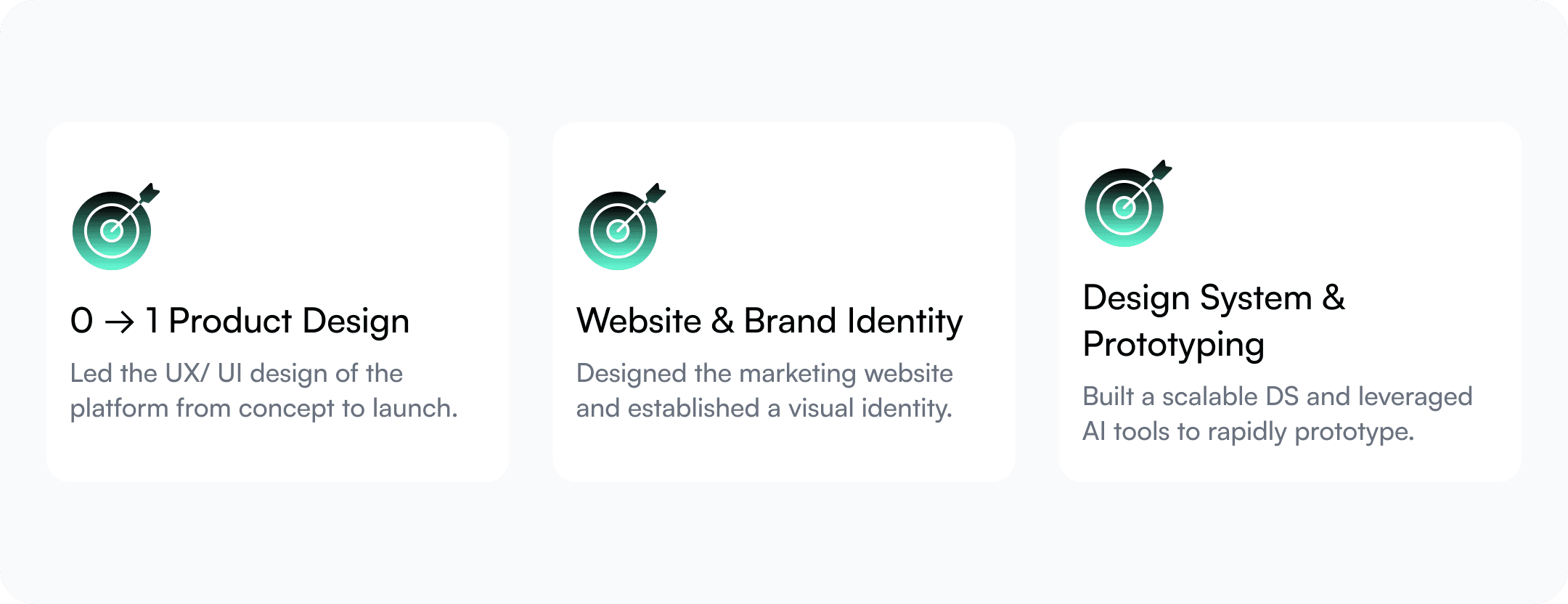
Led the end-to-end design of the AI-powered recruiting platform and marketing website, built a scalable design system, and leveraged AI tools for rapid prototyping and iteration.
Outcome & Impact
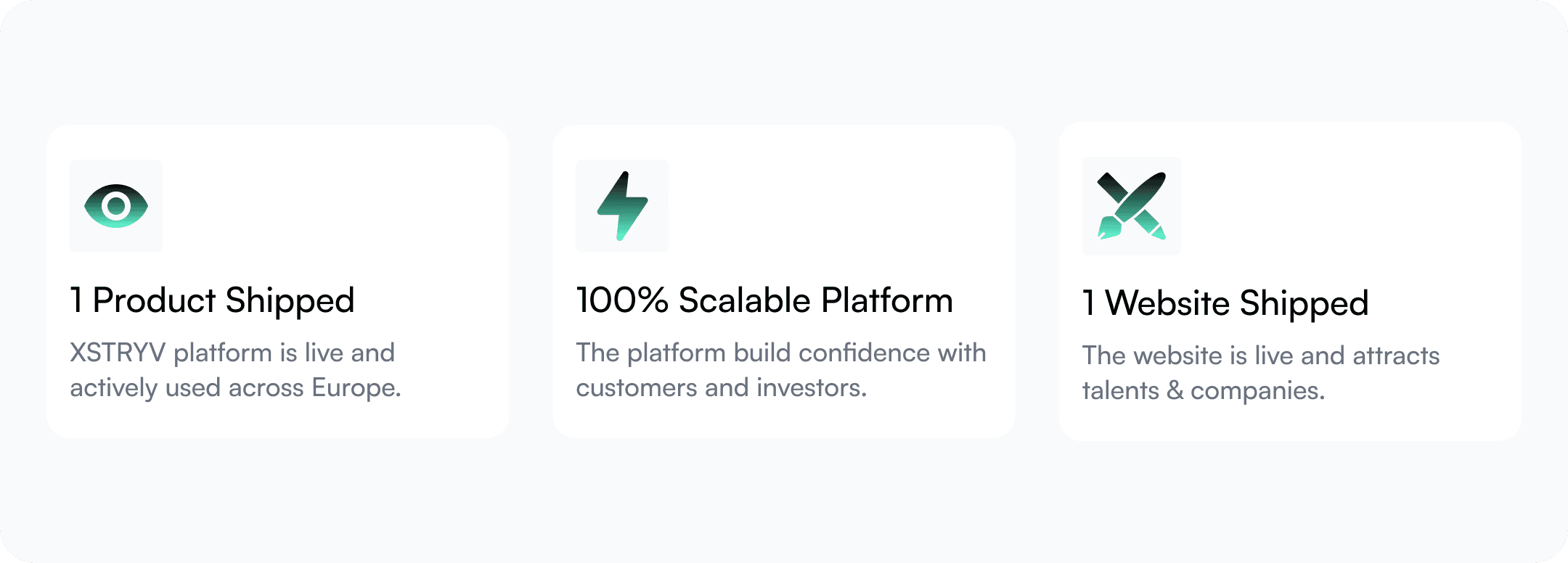
The XSTRYV platform is fully shipped, with a live website featuring a dedicated Unique Opportunities page.
Key improvements included:
Faster candidate screening
Higher recruiter efficiency
Better visibility into AI recommendations
Reduced manual workflow overhead
The Problem
XSTRYV was built to fix early-career hiring. But the deeper problem isn't the algorithm, it's that every AI hiring tool I studied was designed to replace human judgment, not support it. The moment a recruiter can't explain why the system ranked someone first, the tool gets turned off. This case study is about designing an AI hiring product that earns its place in the workflow rather than demanding it.
The Solution
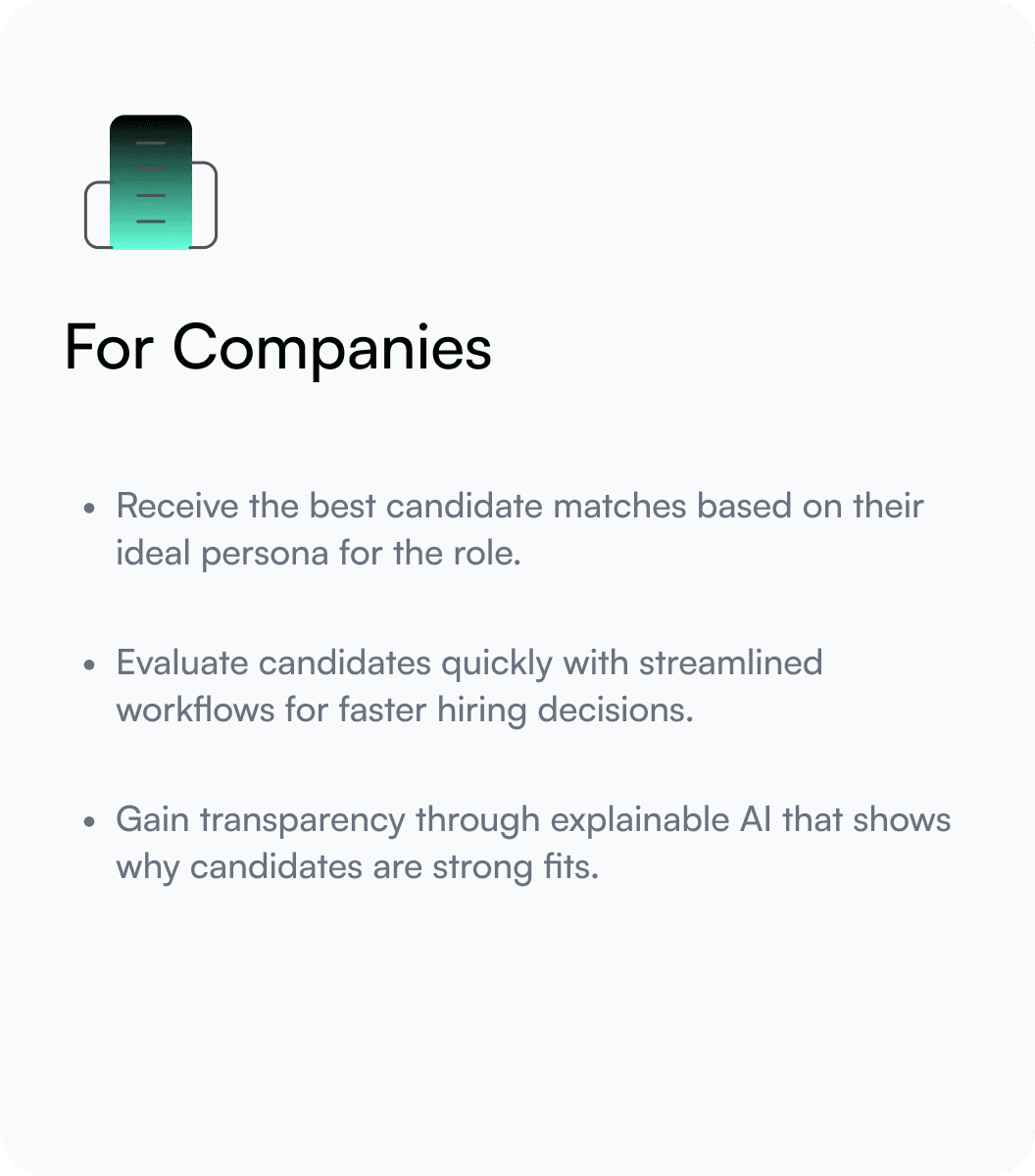
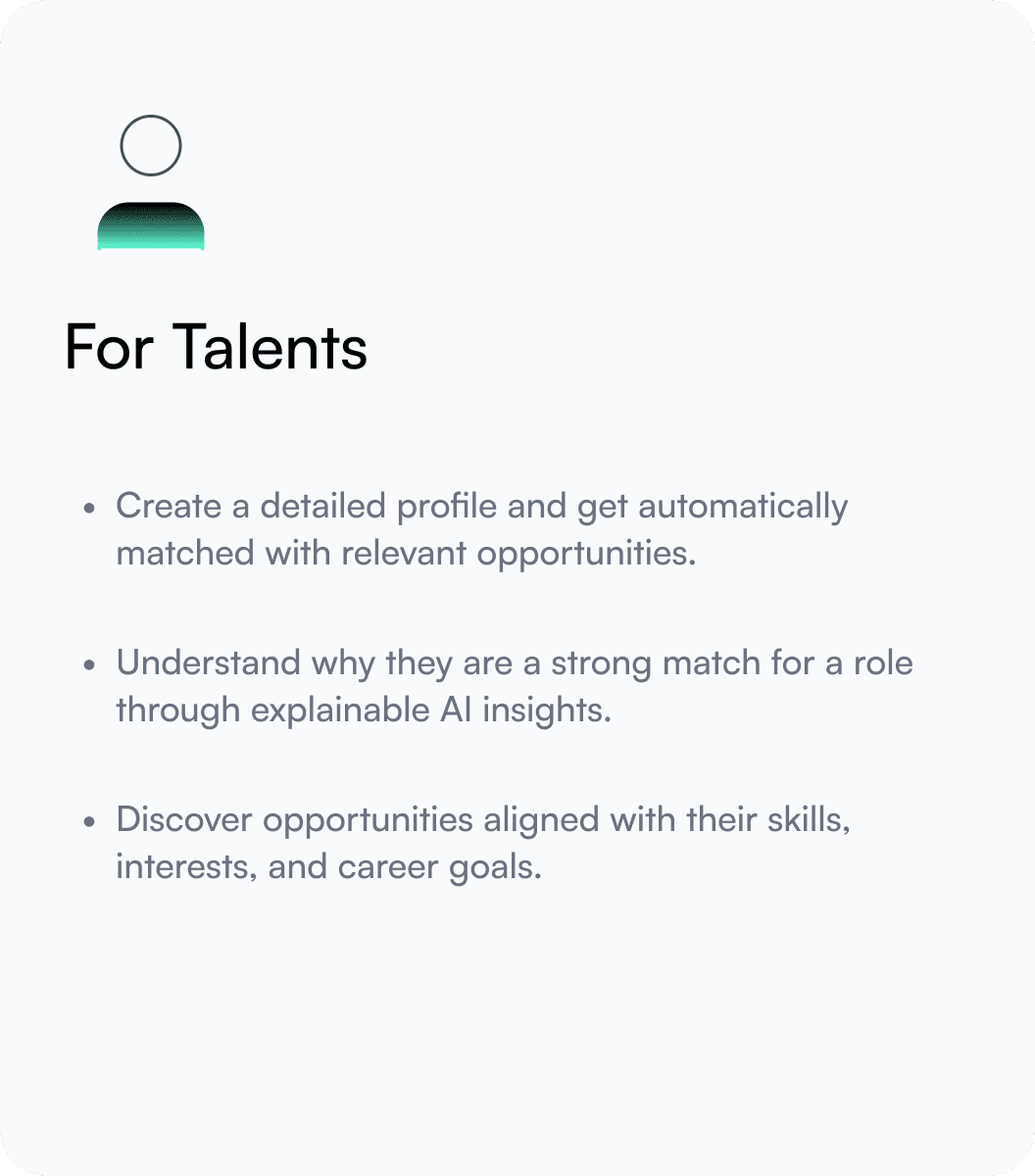
XSTRYV uses AI to automatically match talent with companies, providing explainable insights on why candidates are a strong fit while enabling recruiters to discover, evaluate, and hire the right talent quickly.
The solution offers two connected experiences:
Challenges
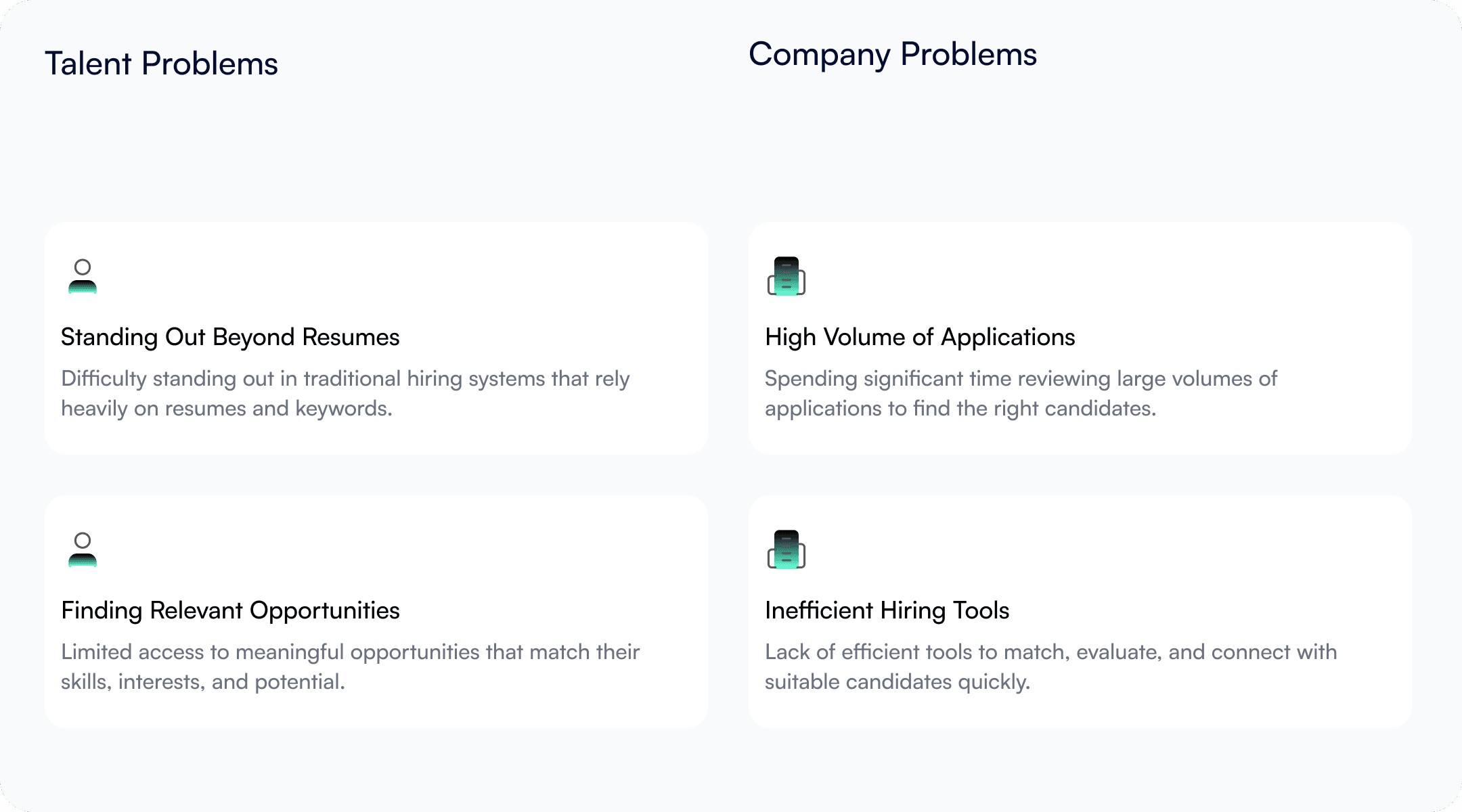
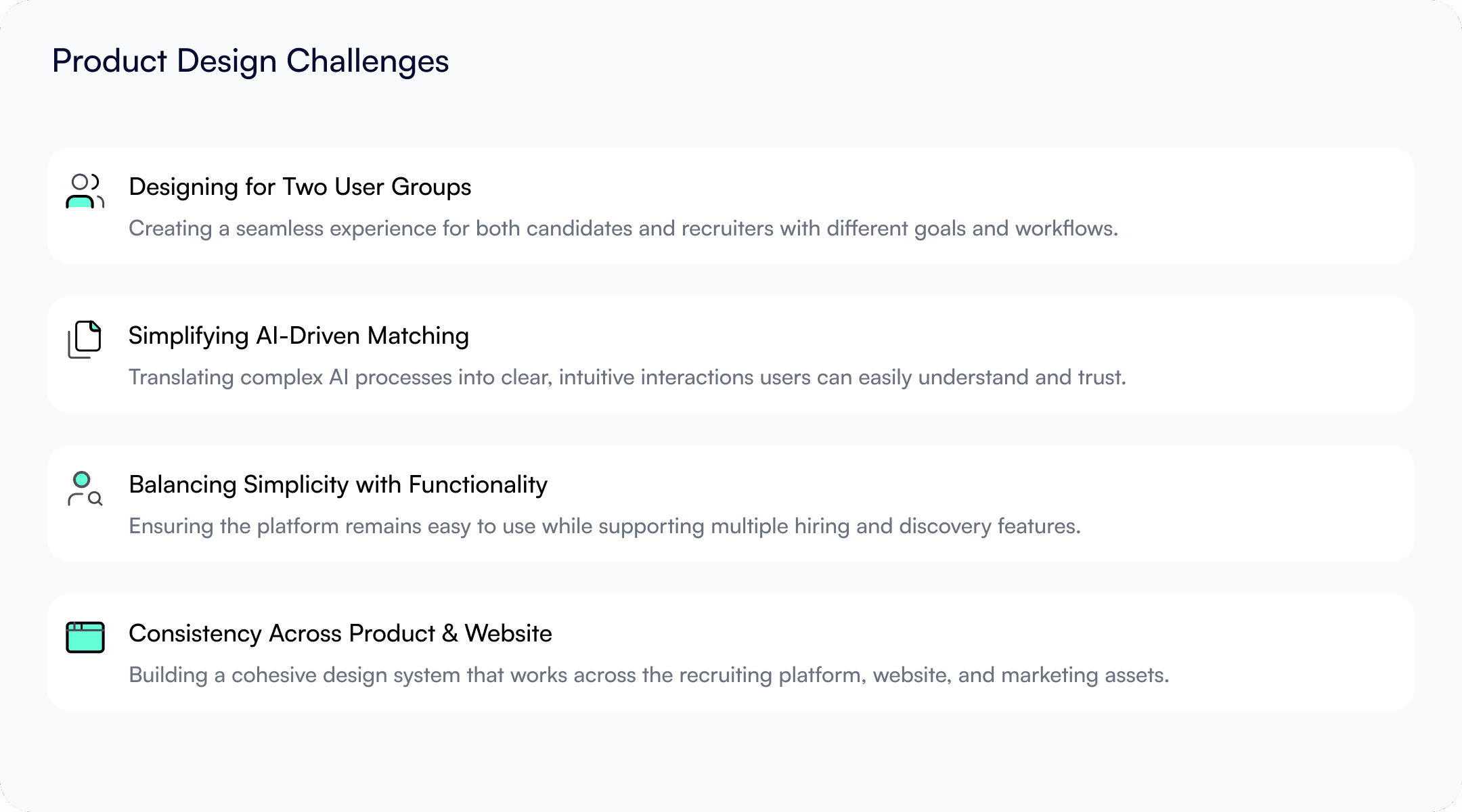
Some of the key challenges are rooted in the complexity of the hiring ecosystem itself.
Design Process
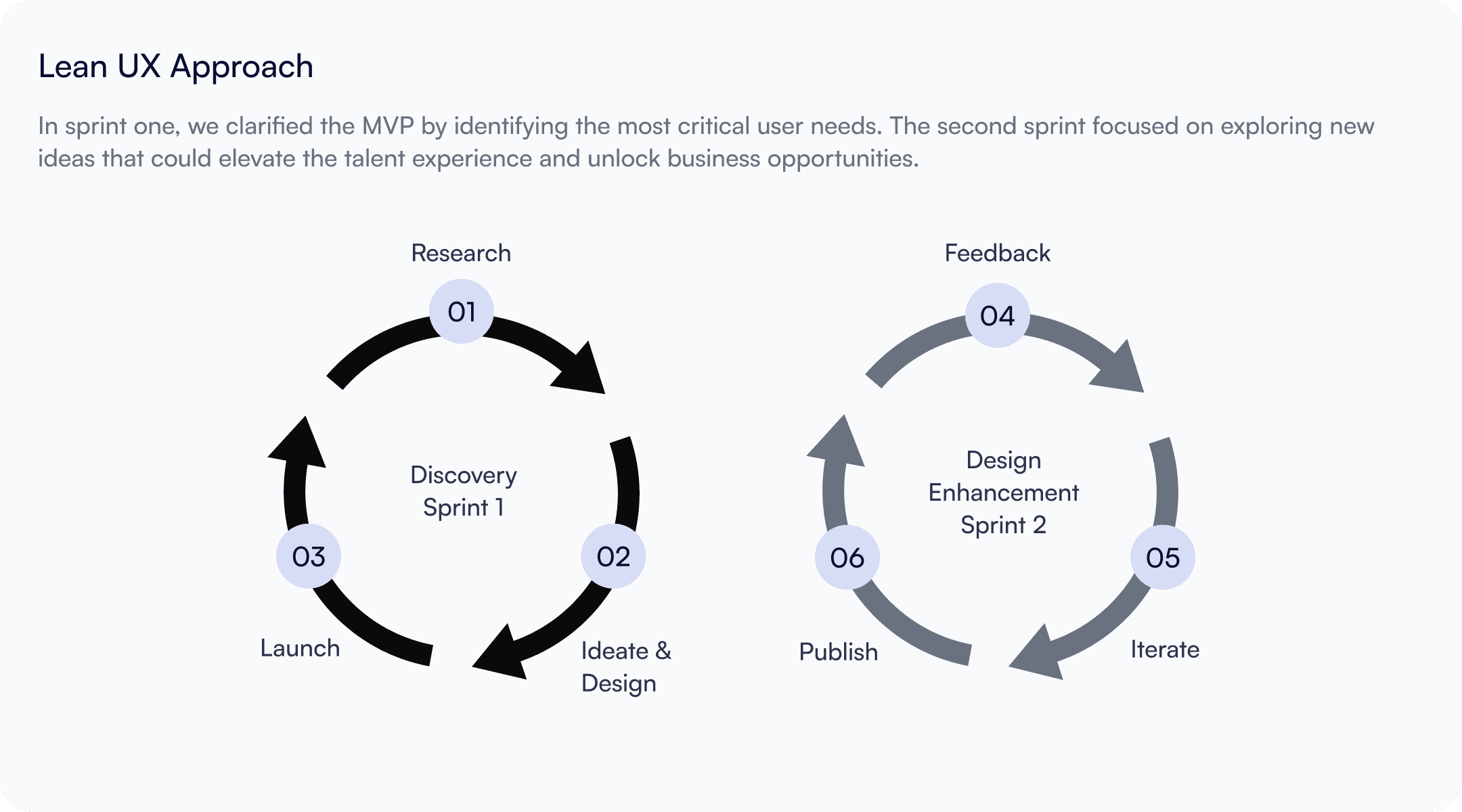
I started by defining the visual and brand identity for XSTRYV to establish a clear product foundation that reflects a modern, AI-powered recruiting platform.
After aligning the website design with the brand direction, I built a scalable design system using shadcn/ui as the base, customizing and extending components to match the product’s needs. I then designed the platform in Figma, focusing on intuitive workflows for both talent and companies.
To rapidly prototype interactions, I connected the designs with Figma Make and experimented with functionality using Google AI Studio. Finally, I integrated the prototype into Cursor to evaluate how the interface translated into a working environment and test the overall product flow.
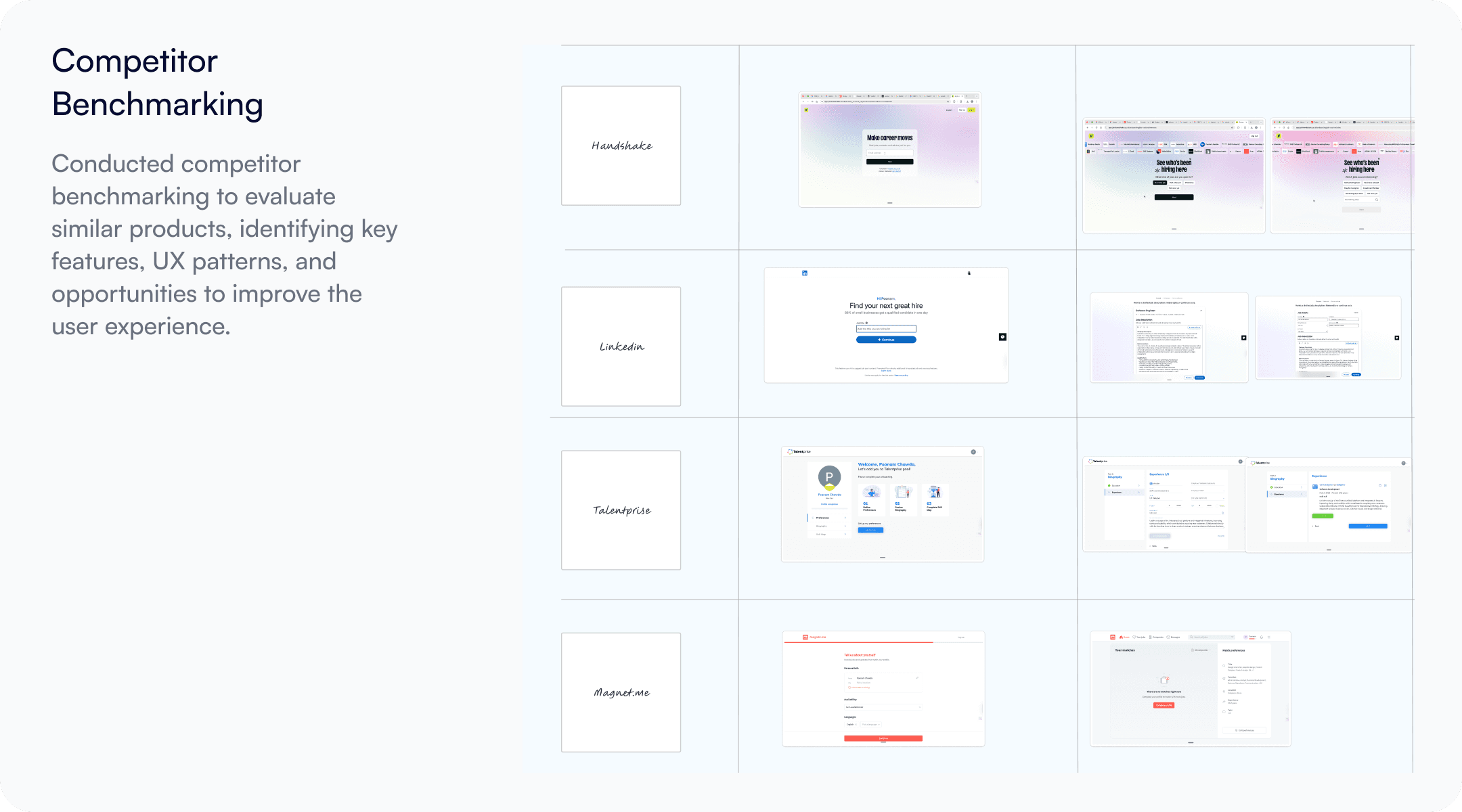
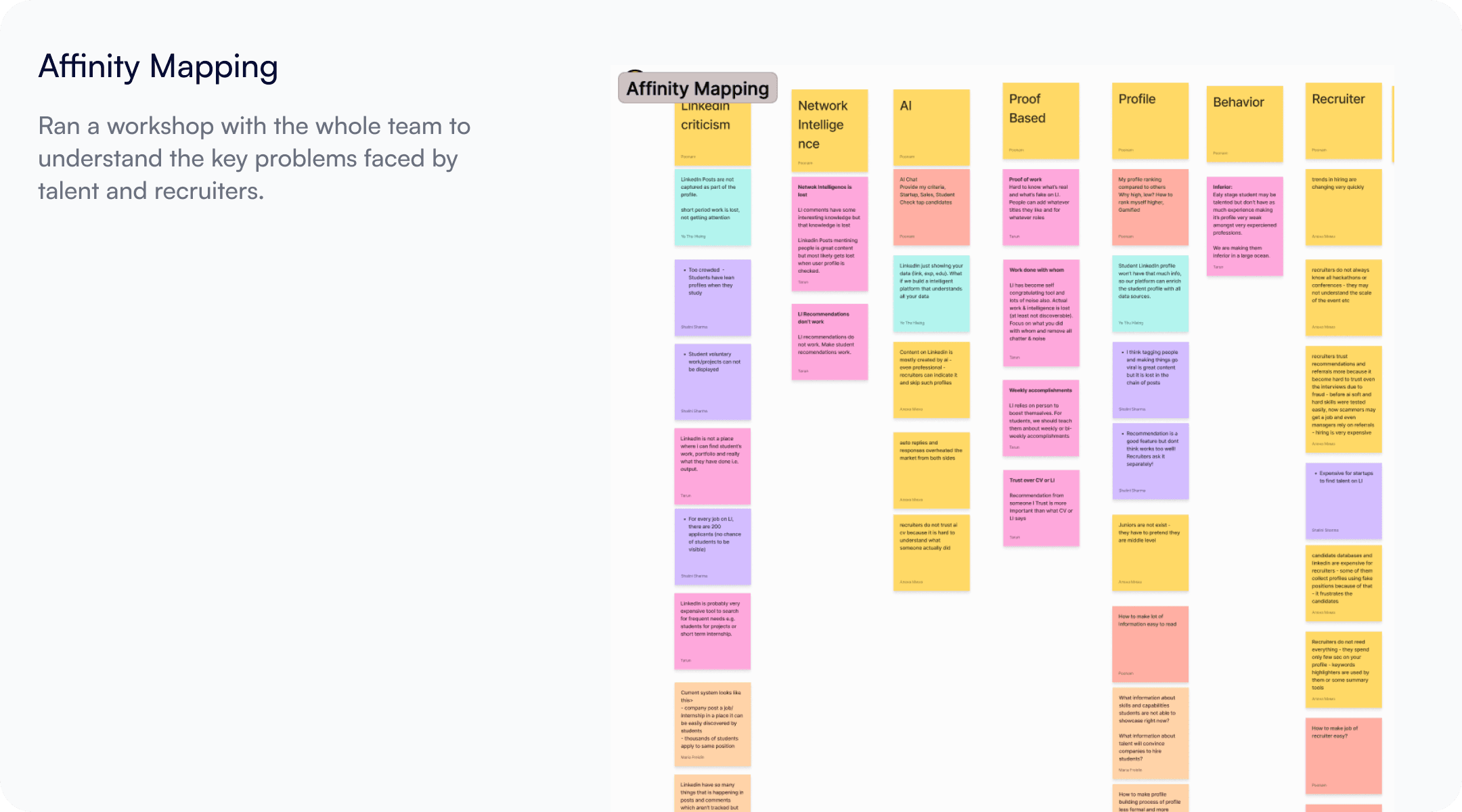
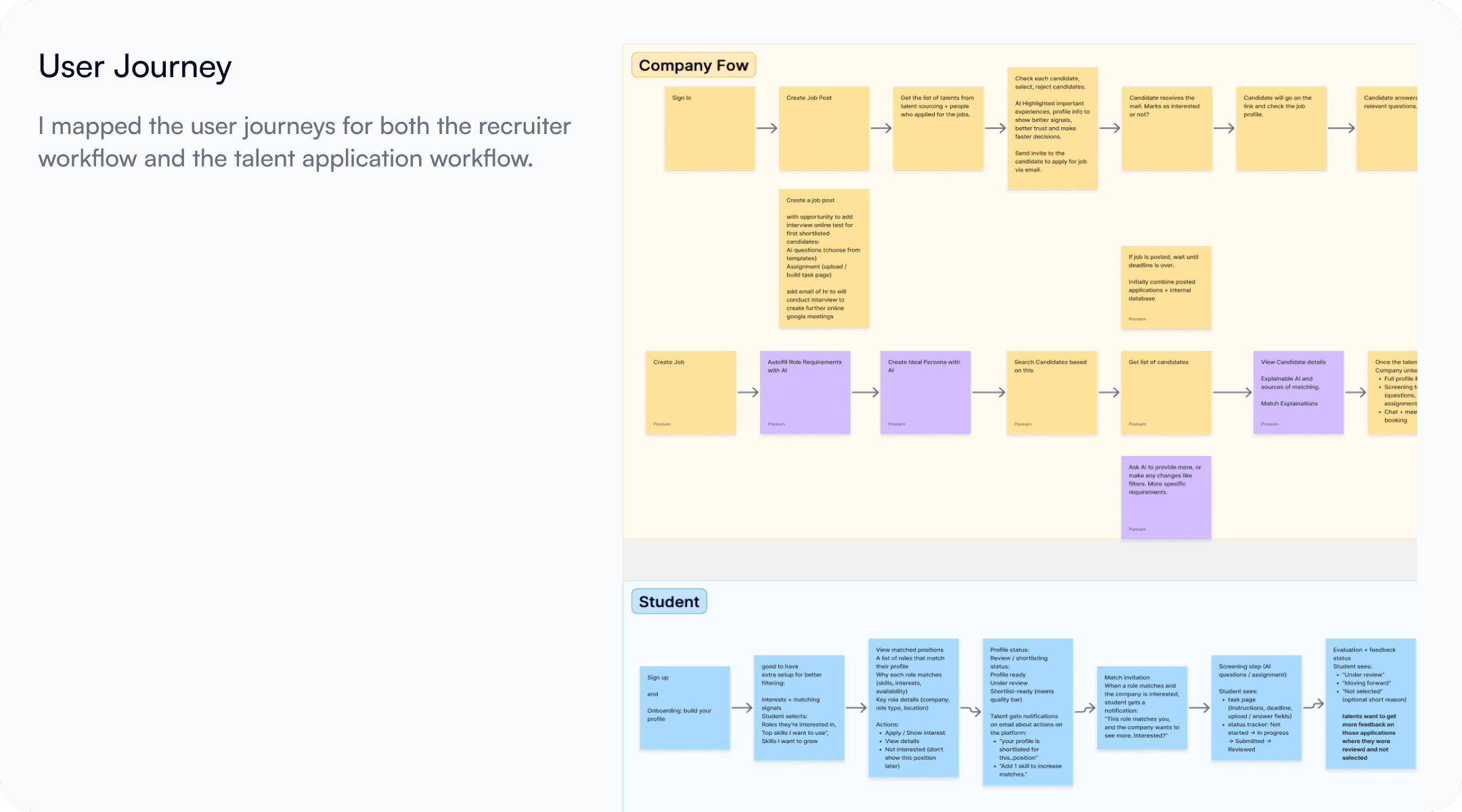
Identifying Design Principles
I started by defining design principles based on our users' pain points and what they valued in their ideal application.
Radical Transparency (Explainable AI)
AI should never be a "black box." Every recommendation or score the system provides must be backed by visible evidence.
Contextual Fluidity
The interface must adapt to the user's intent without forcing them to navigate away from their current task.
Efficiency via Automation (Low Cognitive Load)
Design for "glanceability." Recruiters are overwhelmed, so the UI must surface the most critical data points (Match %, Availability, Core Skills) first, hiding secondary details behind progressive disclosure.
Human-in-the-Loop Interaction
The AI is a "co-pilot," not a replacement. The design must emphasize human agency by providing clear "Action" triggers after every AI insight.
Iterating Layout IA
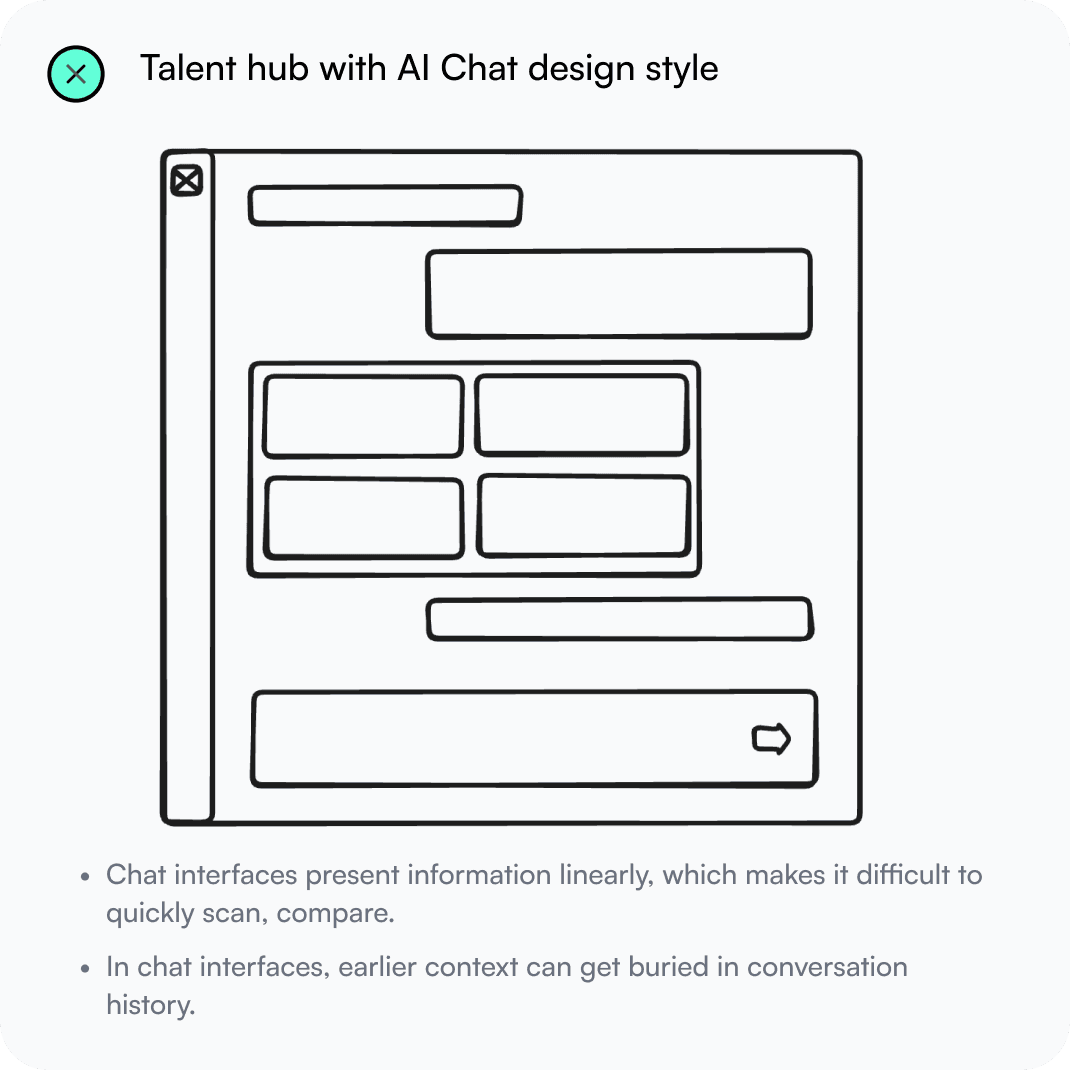
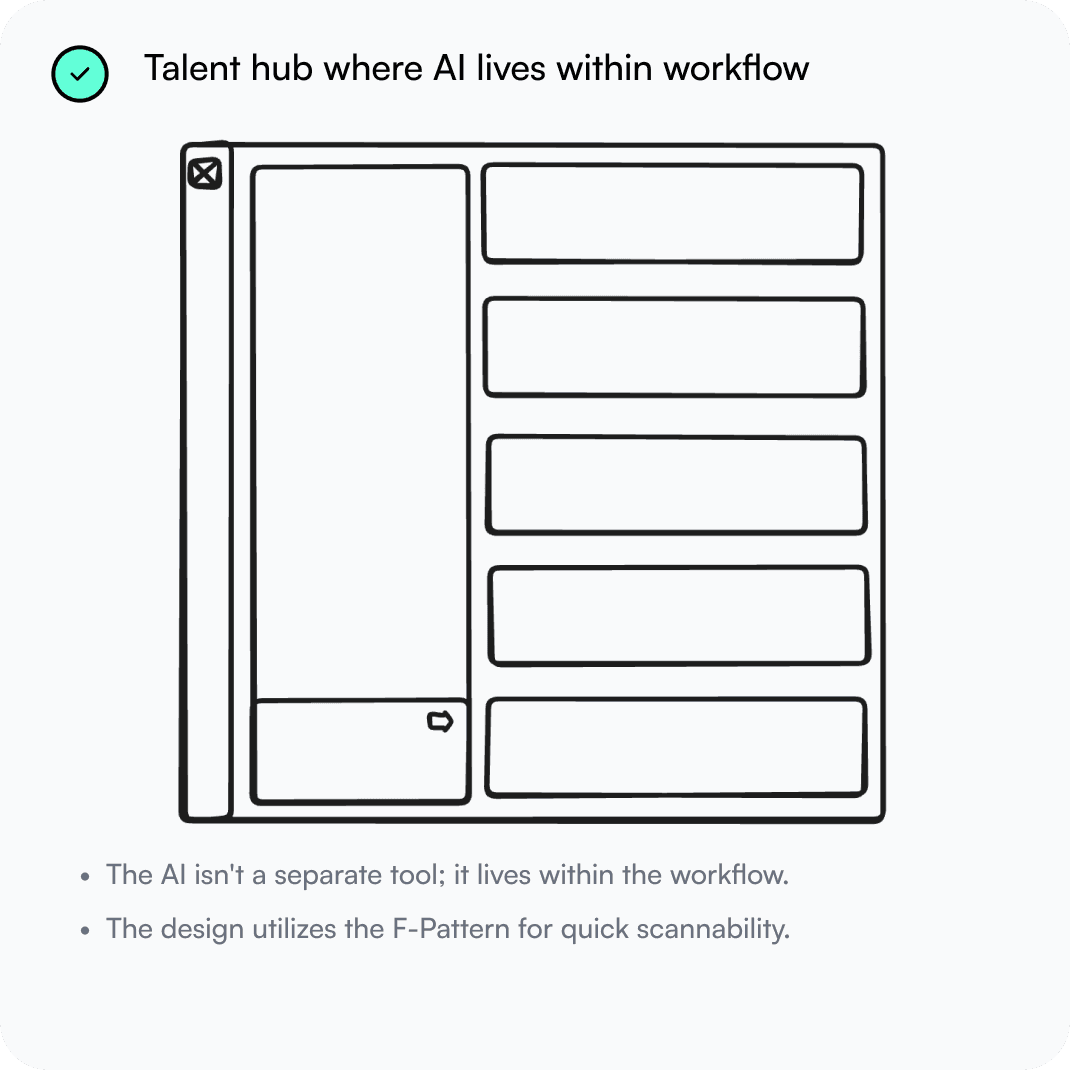
I explored multiple layout directions in Figma to structure the platform for clarity and efficiency. The focus was on creating clean, modular layouts that support quick talent discovery and simple hiring workflows while keeping the interface intuitive for both candidates and companies.
Design System
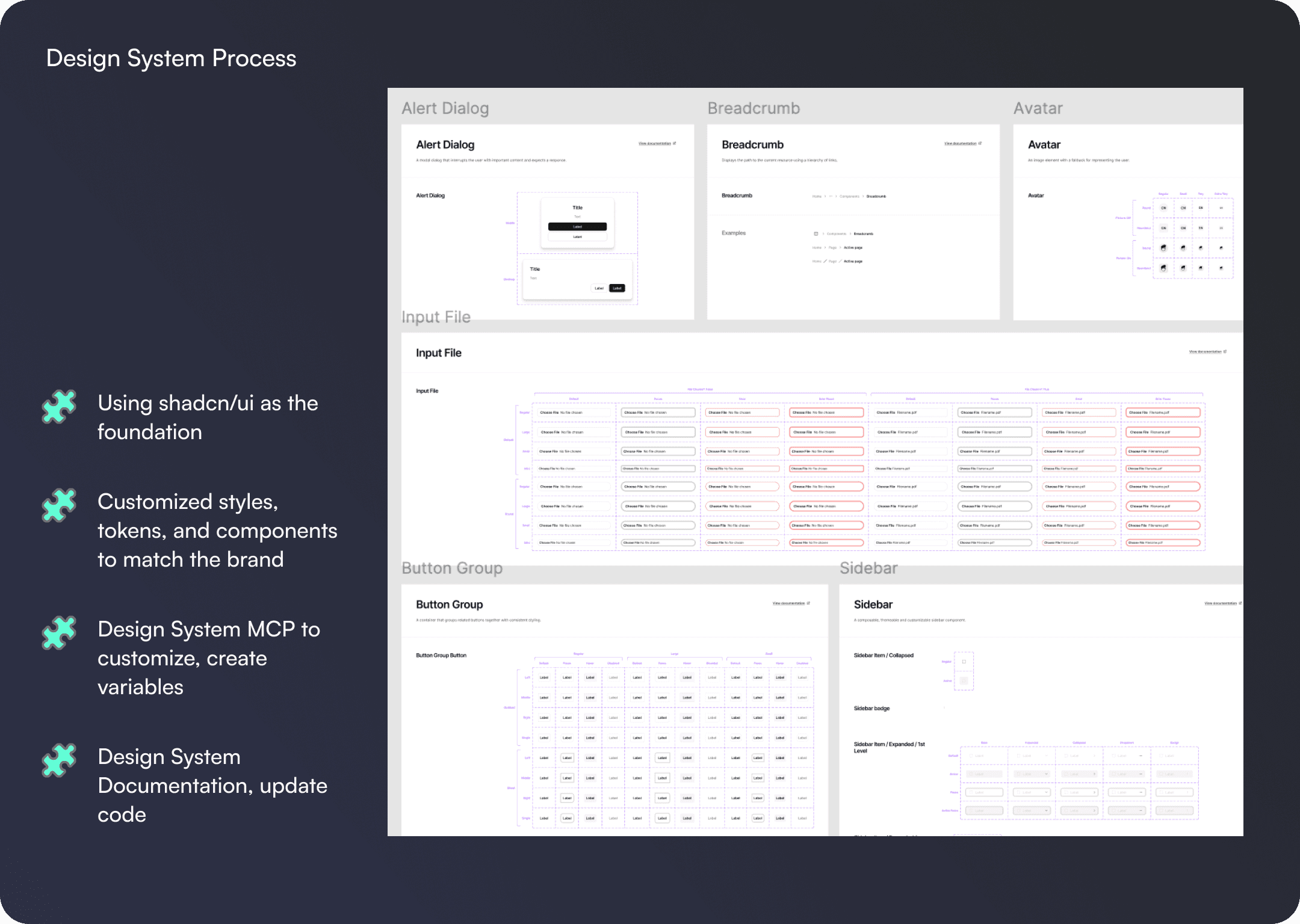
To ensure scalability and consistency across the platform, I created a structured design system for XSTRYV. Using shadcn/ui as the foundation, I customized the visual styles, tokens, and UI components to align with the product’s brand identity.
As the product evolved, I modified existing components and introduced new ones to support AI workflows while maintaining a cohesive and efficient design structure.
FINAL DESIGNS
Employee/Recruiter Overview
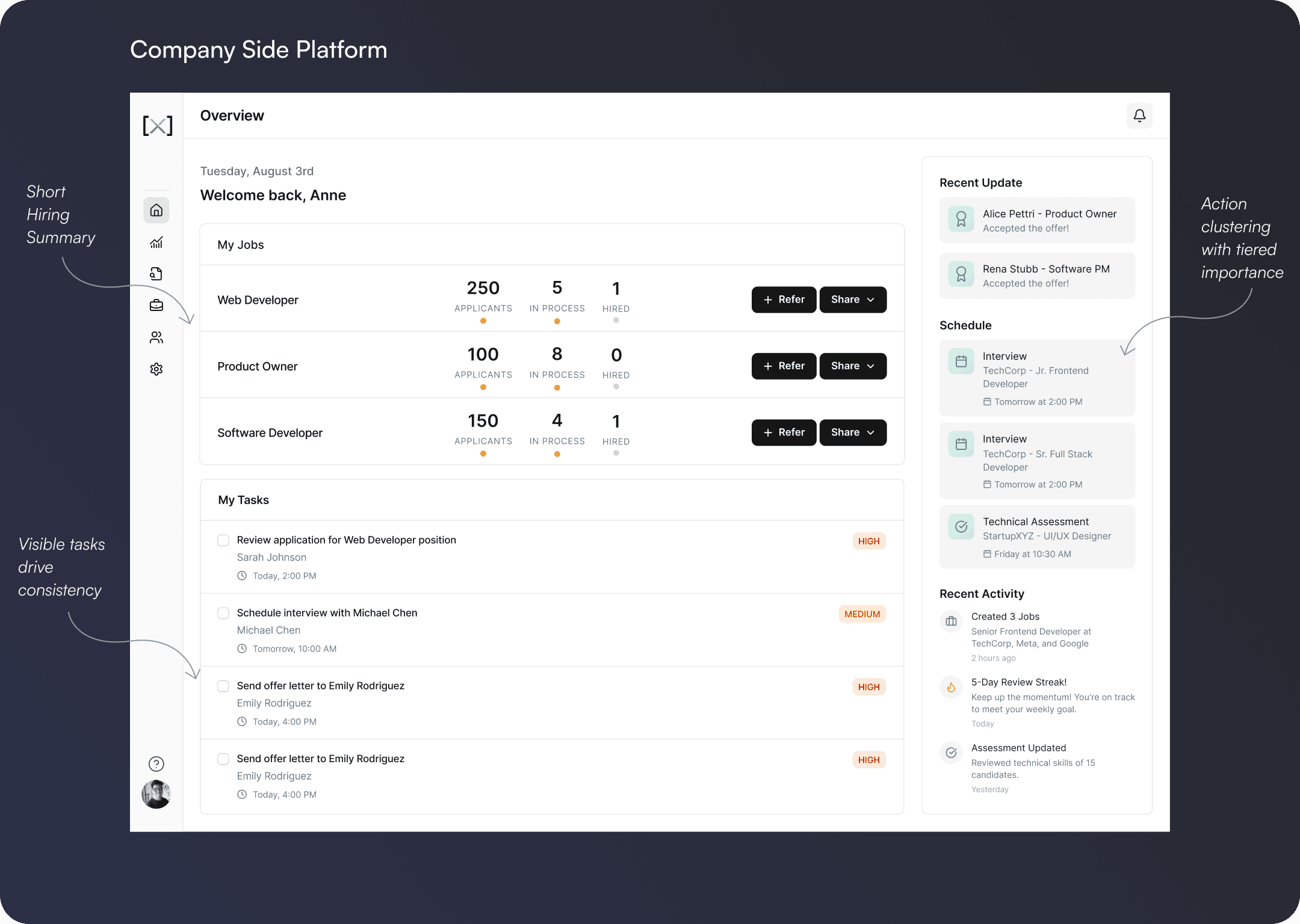
I consolidated real-time pipeline metrics with a prioritized "My Tasks" to-do list featuring urgent status tags. This layout solves the problem of context switching by providing a 360-degree view of the hiring funnel, with the rationale that linking quantitative data (Applicants/Hired) to qualitative actions (Task List) allows recruiters to instantly identify and unblock bottlenecks in the recruitment process.
Talent Discovery with AI
The challenge
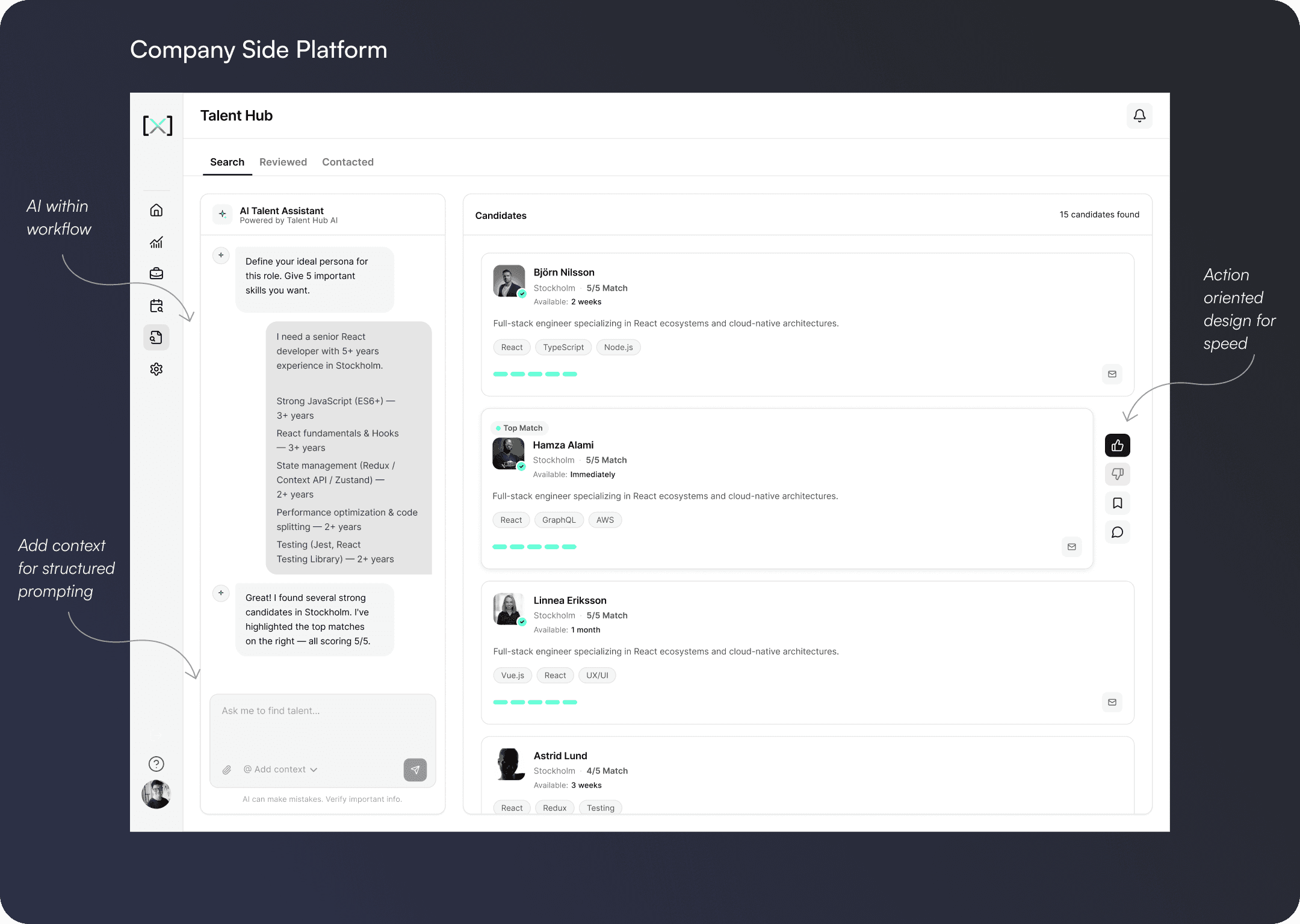
Recruiters needed to evaluate hundreds of candidates while maintaining confidence in AI-generated recommendations.
Most recruiting tools either overwhelm users with raw information or hide important decision-making behind opaque AI scores.
Design decision
Rather than showing a single "Match Score", we exposed the reasoning behind recommendations.
Each candidate card surfaces:
Match percentage
Relevant skills
Experience highlights
AI-generated rationale
This allows recruiters to quickly assess fit while maintaining visibility into how recommendations are generated.
Why it matters
Trust becomes critical when AI influences hiring decisions.
Providing transparent reasoning helped recruiters validate recommendations instead of blindly accepting them.
Talent Details & AI Match Verification
The challenge
Recruiters frequently switched between resumes, job descriptions, and notes to determine whether a candidate was suitable.
This fragmented workflow increased review time and cognitive load.
Design decision
I consolidated candidate insights into a single analysis panel.
The interface combines:
Resume highlights
Skill alignment
Missing qualifications
Recruiter notes
AI recommendations
Why this approach
Instead of replacing recruiter judgment, the design augments it. Recruiters can verify AI recommendations and make faster decisions without losing context.
AI-Powered Candidate Search
The challenge
Recruiters often struggle to translate hiring requirements into effective search queries.
Design decision
I introduced natural language search.
Recruiters can type:
Find senior product designers with SaaS experience and strong stakeholder management skills.
The system automatically converts intent into structured search criteria.
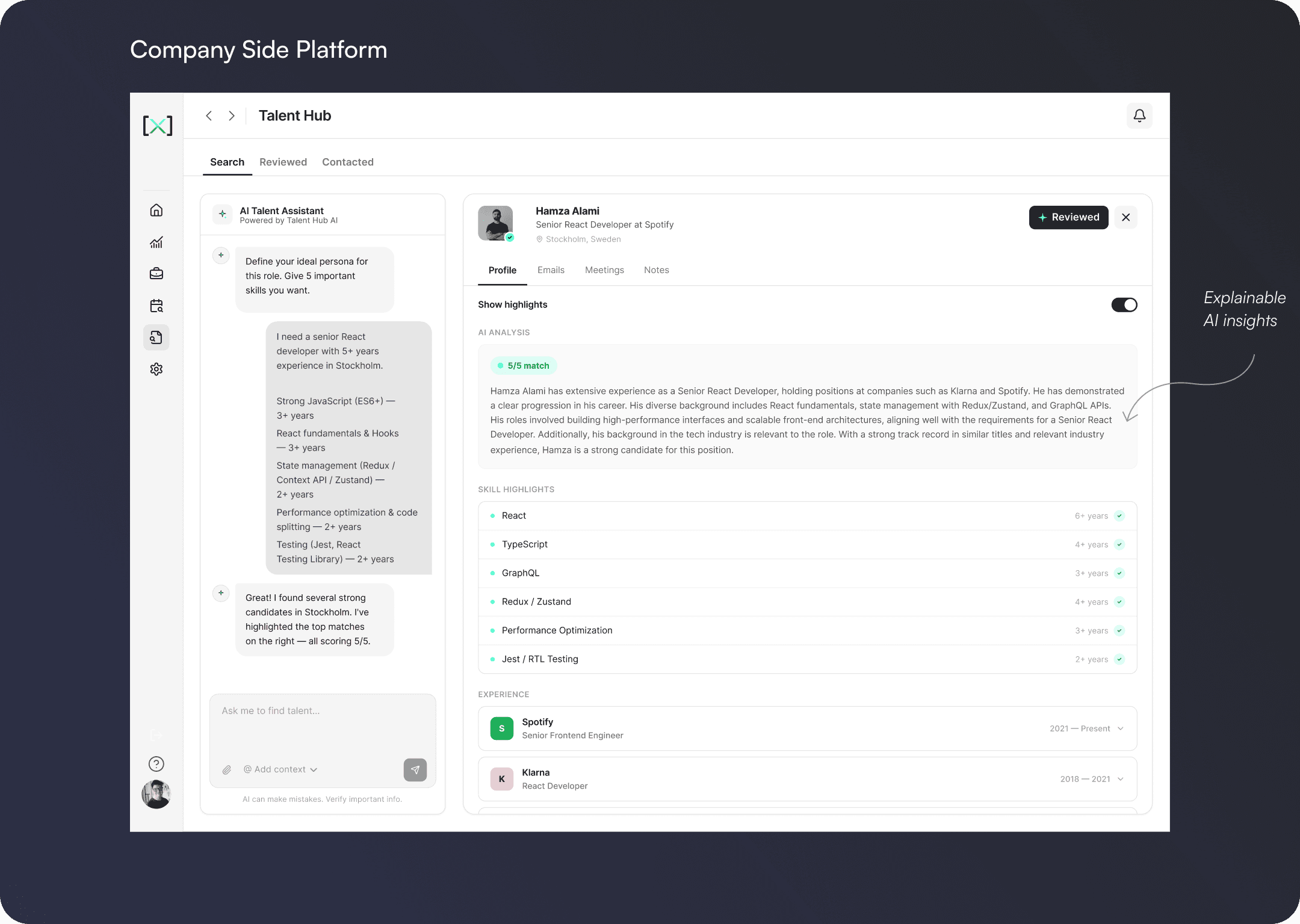
Roles/ Jobs Management
I implemented a "mini-funnel" visualization within each job card. This change solves the problem of information fragmentation by providing immediate visibility into the conversion stages (Reviewed > Interviewed > Hired), with the rationale that quantifying the funnel progress on the grid view allows recruiters to prioritize which roles need urgent sourcing versus those nearing a successful hire.
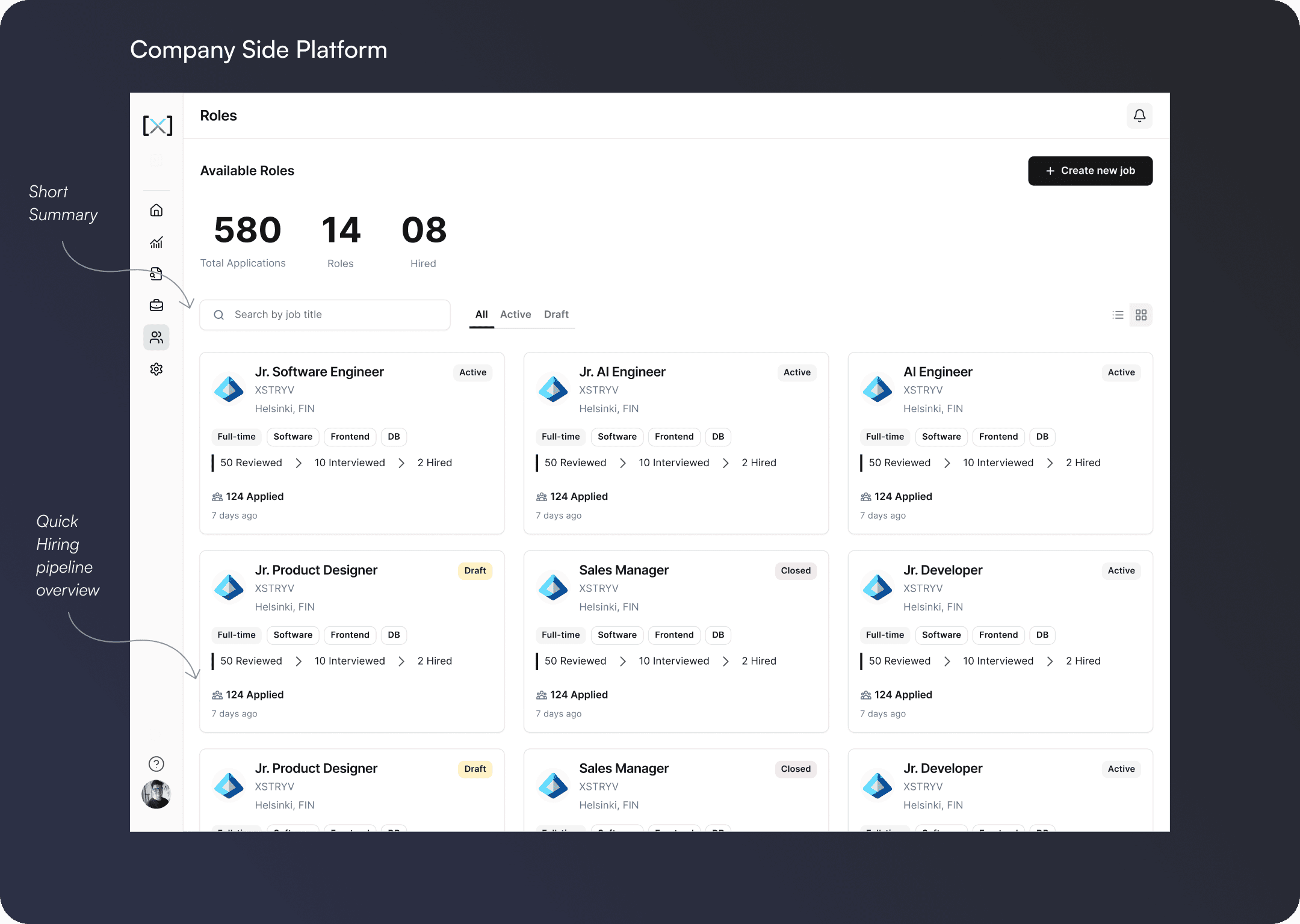
Talent Dashboard
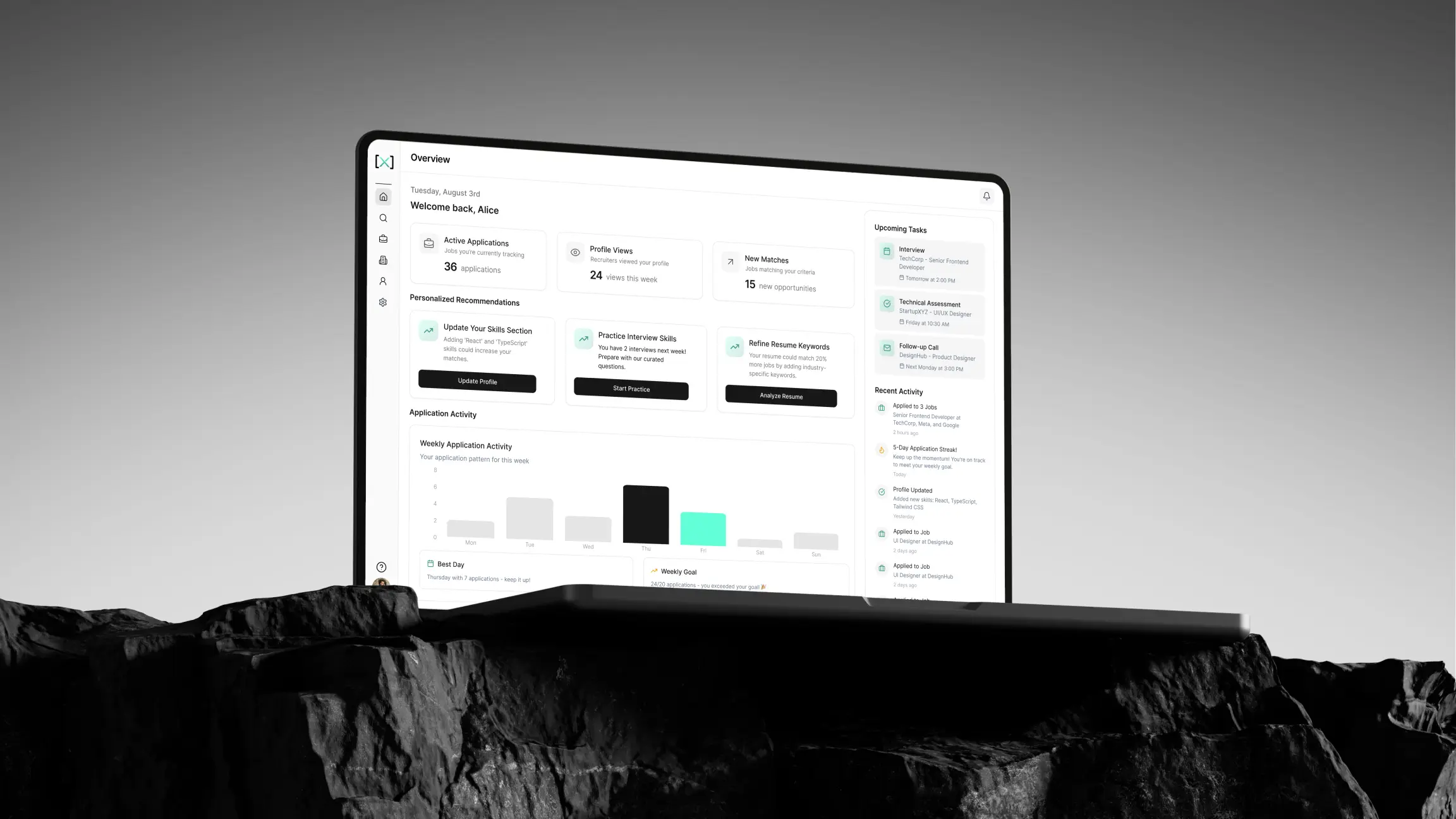
I structured the layout to highlight progress as the primary value drivers while introducing a gamified "Weekly Activity" tracker. The "Personalized Recommendations" address user drop-off by providing clear next steps. Through recent activity and upcoming tasks, candidates stay engaged with their career growth.
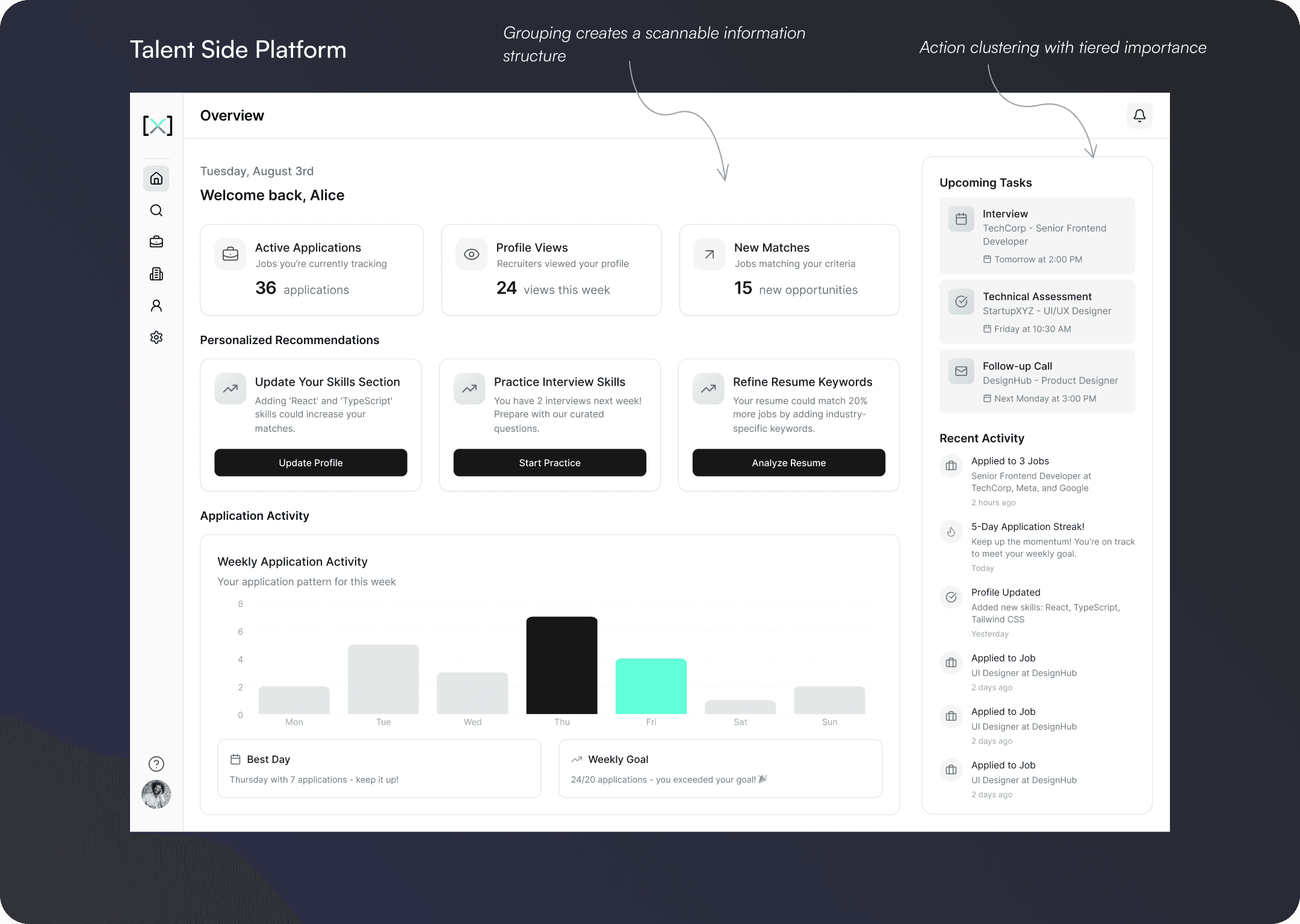
Job Feed & Discovery
AI insights about the role and work solve the problem of "scan fatigue", with the rationale that visibility of a good fit drives a sense of urgency and realistic expectations for the candidate. The "Best Matches" tab with a notification badge (10) reduces time-to-apply. I introduced a structured card-based grid with categorical tag hierarchies and "Applied" count indicators.
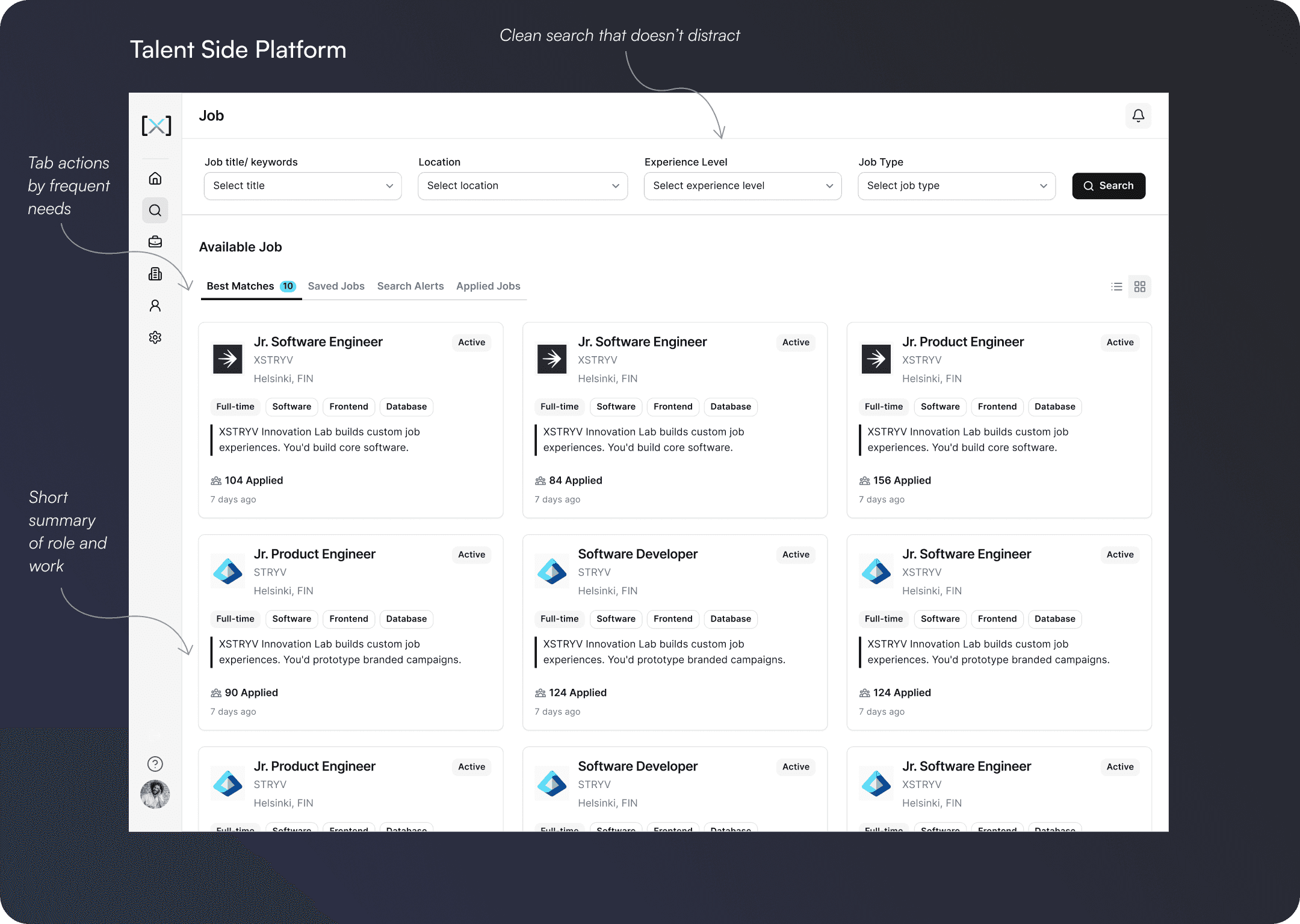
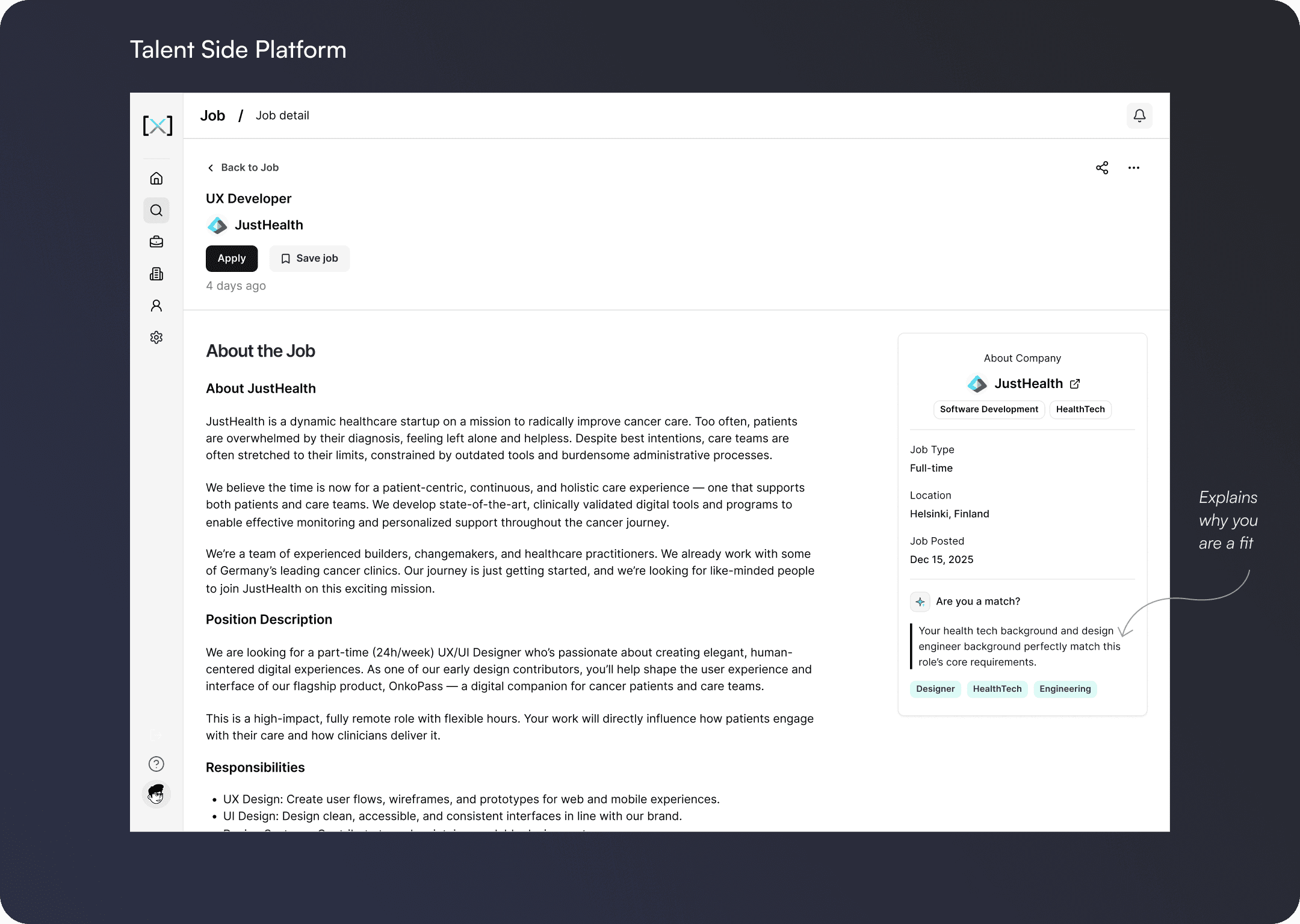
Job Detail & AI Match Verification
Challenge
Candidates struggled to determine whether a role matched their skills without manually comparing their experience against lengthy job descriptions.
Solution
Introduced an AI-powered match panel that analyzes the candidate's profile and explains why they are a strong fit for the role, highlighting relevant skills and experience.
Design Rationale
Rather than showing a generic match score, the recommendation provides transparent reasoning to build trust and help users make faster, more informed application decisions.
Impact
Reduced decision-making effort and increased confidence when evaluating job opportunities.
Learnings
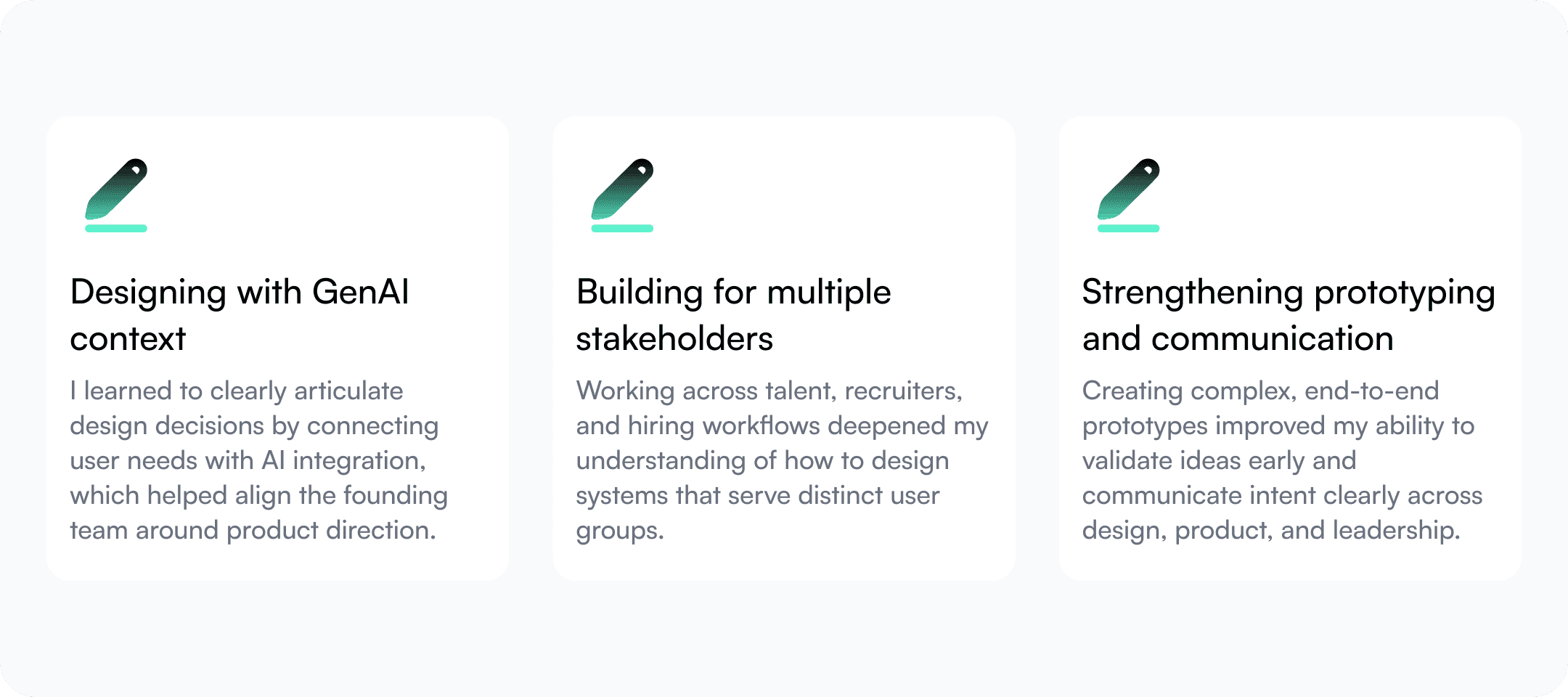
Studying GenAI UX patterns helped me integrate AI-driven features seamlessly, creating intuitive workflows and meaningful interactions.
Integrating AI features highlighted the need for transparency and trust in AI-driven experiences, making GenAI patterns crucial.
Aligning brand identity with product design demonstrated how cohesive visuals and messaging enhance credibility and user engagement.
My Reflections
Working on XSTRYV reinforced the importance of designing for multiple user groups with distinct needs while maintaining a cohesive experience.
Building a flexible design system early accelerated iteration and ensured consistency across product and marketing channels.
Leveraging AI tools for prototyping allowed rapid experimentation and validation, while aligning brand identity with the product experience made the platform feel polished, trustworthy, and engaging for both talent and companies.